
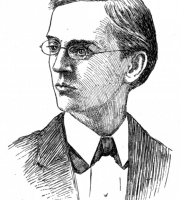
About Irwin Russell
Irwin Russell was an American poet and lawyer. He was born in Port Gibson, Mississippi, on June 3,1853. His father worked as a physician, and his mother was a teacher at the Port Gibson Female College. Despite injuring an eye when he was only two, the young boy could read easily by age four. Just two years later, he was actually reading the complex poetry of John Milton. Around this time, his family relocated to St. Louis. However, their sympathy for the South brought them back to Port Gibson right into the middle of the Civil War and the difficult Reconstruction years.Eventually, he finished his formal schooling with distinction at the University of St. Louis. In the meantime, he tried his hand at writing. Like many southern authors of his day, he also aspired to be a lawyer. He started out as an apprentice in the office of Judge L. N. Baldwin. Later on, thanks to a special act of the Mississippi legislature, Russell was admitted to the bar at the remarkably young age of nineteen. He didn't practice law for long, though. Soon struck by wanderlust, he traveled to New Orleans and then out to Texas. After this brief period of roaming, he came back to Port Gibson and finally began to write seriously.
He received strong encouragement from Henry C. Bunner, the editor of Puck, as well as Richard Watson Gilder and Underwood Johnson from Scribner’s Monthly Magazine. With their backing and his father's good wishes, Russell made the big decision to pursue a literary career in New York.
Even before leaving Mississippi, he had already built a name for himself. He published a long list of items in Scribner’s Monthly, which included: “Uncle Cap Interviewed” (January 1876); “Half Way Doin’s” (April 1876); “Nebuchadnezzar” (June 1876); “Precepts at Parting” (September 1876); “The Old Hostler’s Experience” (November 1876); “The Mississippi Witness” (December 1876); “Novern People” (January 1877); “Mahsr John” (May 1877); “The First Client” (August 1877); “Christmas Night in the Quarters” (January 1878); “Irish Eclipse” (May 1878); “Opinions of Captain Delacy” (August 1878); “The Hysteriad” (September 1878); and a prose piece called “The Fools of Killogue” (October 1878). This catalog contains most of his best poems.
His prose work was also appearing in northern magazines during this same period. Popular Science Monthly published his essay “Of the Uncertainty and Vanity of the Sciences” in July 1876. Over at St. Nicholas magazine, readers saw “Sam’s Four Bits” (August 1876), “On the Ice” (March 1877), and “Sam’s Birthday” (May 1878).
Russell arrived in New York City in January 1879, and every sign pointed toward literary success. His friend, Charles C. Marble, had this to say about his time there:
“Russell lived in New York about six months, from January to July 1879. He loitered at old bookstalls and snatched many a delight from the exposed stores. Only Charles Lamb, with his quiet tastes after his emancipation from the India House, when, as he expressed it, he was 'Retired Leisure,' got more from them. Especially was everything old sought by him: old prints, of which he was critically fond; black-letter volumes, for he was a connoisseur in printing, recognizing at a glance the various types used in book making.”
He soon became a featured writer in the “Bric-A-Brac” section of Scribner’s Monthly. It was clear that Gilder and Johnson saw great possibilities in him. During the Reconstruction era and the years immediately following, the magazine's policies heavily favored authors who wrote without malice or sectionalism.
At the time, the South was full of picturesque scenes and unique dialects, which provided a rich vein of local color material for writers. We see this in Joel Chandler Harris’s Georgia characters, George Washington Cable’s Louisiana Creoles, and Russell’s focus on the African American communities in Mississippi. Alongside writers like Thomas Nelson Page, Russell portrayed these characters and their dialects in his contributions to Scribner’s Monthly. For students studying this period, it's important to note that their stories were relatively free of political propaganda. Instead, they presented these characters and their everyday philosophies against colorful, regional backdrops. For publishers like Gilder, the goal was to present these characters against colorful, regional backdrops to entertain a national audience. Through his magazine, Gilder made sure his contributors were writing literature that felt thoroughly American, attempting to bridge the deep regional divides left by the war.
Browse all poems and texts published on Irwin Russell