
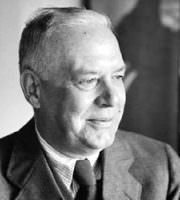
About Wallace Stevens
Wallace Stevens (1879-1955) was an American modernist poet, born in Pennsylvania. After studying law, he became a businessman: vice president of an insurance company, in Hartford, Connecticut. He practically spent all his life between his office and his home. He owned a significant art collection, and “contemplation,” according to him, should be the poet's instrument. Stevens's poetry only emerged late in life, at the age of 35: although he had already published poems from 1898 to 1900 in the Harvard Advocate and the Harvard Monthly, it was only in 1914, under the pseudonym Peter Parasol, that he wrote and submitted poems, “Phases”, to Poetry magazine for a competition on the theme of war. He did not win, but was published by the magazine a little later. His first and most influential book, Harmonium, was not published until he was forty-four years old in 1923. In these poems, Stevens drew on his interest in and understanding of modernism. Over time, he became acquainted with the most accomplished of his contemporaries, Robert Frost and William Carlos Williams among them, but his personal style remained unique. However, he only achieved fame a year before his death, with the publication of his collected poems under the title “Collected Poems”. Combining poetry with his legal practice, he published a slightly revised and amended second edition of Harmonium in 1930. Stevens himself indicated the three basic orientations of his work: “abstraction, metaphor, and pleasure,” and this general principle: “reality is what is perceived through the mind.” In February 1947, he published his volume of poems, “Transport to Summer”, which was favorably received by F. O. Mathiessen in The New York Times. In the eleven years preceding this publication, Stevens had written three volumes of poetry: “Ideas of Order”, “The Man with the Blue Guitar”, and “Parts of a World”. All of these poems were written before Stevens began work on his poem “The Auroras of Autumn”, which was also very well received.Some of his best-known poems include Anecdote of the Jar, Disillusionment of Ten O'Clock, The Snow Man and Thirteen Ways of Looking at a Blackbird. According to the literary critic Harold Bloom, who called Stevens the best and most representative American poet of the time, no western writer since Sophocles has had such a late flowering of artistic genius.
Less recognized during his lifetime than other poets of his generation (such as Ezra Pound and T. S. Eliot), he received the National Book Award for his Collected Poems and the Pulitzer Prize in 1955. That same year, he was awarded an honorary degree by Yale University. He spent most of his life working as an executive for an insurance company in Hartford, Connecticut.
Browse all poems and texts published on Wallace Stevens
A poem need not have a meaning and like most things in nature often does not have.