
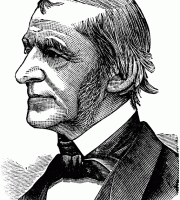
About Ralph Waldo Emerson
Ralph Waldo Emerson (May 25, 1803, in Boston — April 27, 1882, in Concord), was an American poet, essayist and philosopher, leader of the American transcendentalist movement of the early 19th century. He was a poet who become known for challenging traditional thought. Emerson wrote a poetic prose, ordering his essays by recurring themes and images. His poetry, on the other hand, is often called harsh and didactic.Upon entering Harvard University in 1817, he began a journal that he would keep throughout his life. It was the source from which he often drew material for his lectures and essays. Ordained a Unitarian minister in 1829, he took charge of the Second Church of Boston, as his father had done before him. The death of his wife in 1831 triggered a crisis in the writer: Emerson abandoned his pastoral duties a year later and embarked on a journey through Europe (Italy, France, Great Britain, etc.). He met, among others, Coleridge, Wordsworth, and Carlyle, with whom he formed a close friendship. Upon his return to the United States, he believed he had found his calling: he became a lay preacher in the kind of cultural societies known as the Lyceums of New England. He remarries and settles in the small village of Concord, which has become the center of transcendentalism, a philosophy that advocated the need for knowledge that transcends experience.
He anonymously published his first book, a short essay entitled Nature, in September 1836. In it, he notably argues that “what is most 'useful' to man is to contemplate nature without disturbing its order, in order to become a 'transparent pupil' within it.” This book was something of a compendium of his doctrine. Emerson then undertook the revision of his lectures for the publication of his two volumes of “Essays” (1841 and 1844). Three years later he published his volume “Poems” (1847). When, in 1848, he made his second trip to Europe, he did so as an illustrious representative of the thinkers of the young Republic. Upon his return, he compiled the lectures he had delivered under the title “Representative Men” (1850), along with a series of new essays, “English Traits” (1856). He traveled throughout the United States, took a stand on the main issues of the time (primarily slavery), and witnessed the Civil War as a painful observer: his sympathies and his public activity were always in the service of the Union.
Browse all poems and texts published on Ralph Waldo Emerson
Write it on your heart that every day is the best day in the year. He is rich who owns the day, and no one owns the day who allows it to be invaded with fret and anxiety. Finish every day and be done with it. You have done what you could. Some blunders and absurdities, no doubt crept in. Forget them as soon as you can, tomorrow is a new day; begin it well and serenely, with too high a spirit to be cumbered with your old nonsense. This new day is too dear, with its hopes and invitations, to waste a moment on the yesterdays.